With Elon Musk, it is always difficult to separate the business from the circus.
There are the feuds, the political interventions, the outrageous predictions and the daily melodrama. Whether you love him or hate him, the Musk world has become a kind of global soap opera, played out across social media, financial markets and, increasingly, geopolitics.
The SpaceX IPO was no different. It was a mega-IPO conducted on Musk’s terms: enormous retail interest, an unconventional sales process, a record amount of capital raised and a valuation approaching $2 trillion when trading began. The offering raised more than $75 billion, providing SpaceX with an extraordinary war chest for its next phase of expansion.
It is easy to be distracted by the theatre. It is even easier to look at a valuation of $1.6 trillion and declare the whole thing absurd.
But behind the Musk circus sits an extraordinary business.
Reinventing the rocket isn’t easy. Space launch is one of the most technically challenging industries in existence. For much of the previous 60 years, it also changed surprisingly little.
Apollo 11 launched on 16th July 1969 using the Saturn V rocket. It remains one of humanity’s greatest engineering achievements. But its basic economics were appalling: almost the entire launch system was used once and discarded.
Remarkably, many launch systems developed by NASA and the European space industry during the 2000s and 2010s still follow broadly the same model. A gigantic, extraordinarily expensive machine is constructed, launched and then largely thrown away. The small capsule or spacecraft at the top may return, but most of the launch vehicle does not.
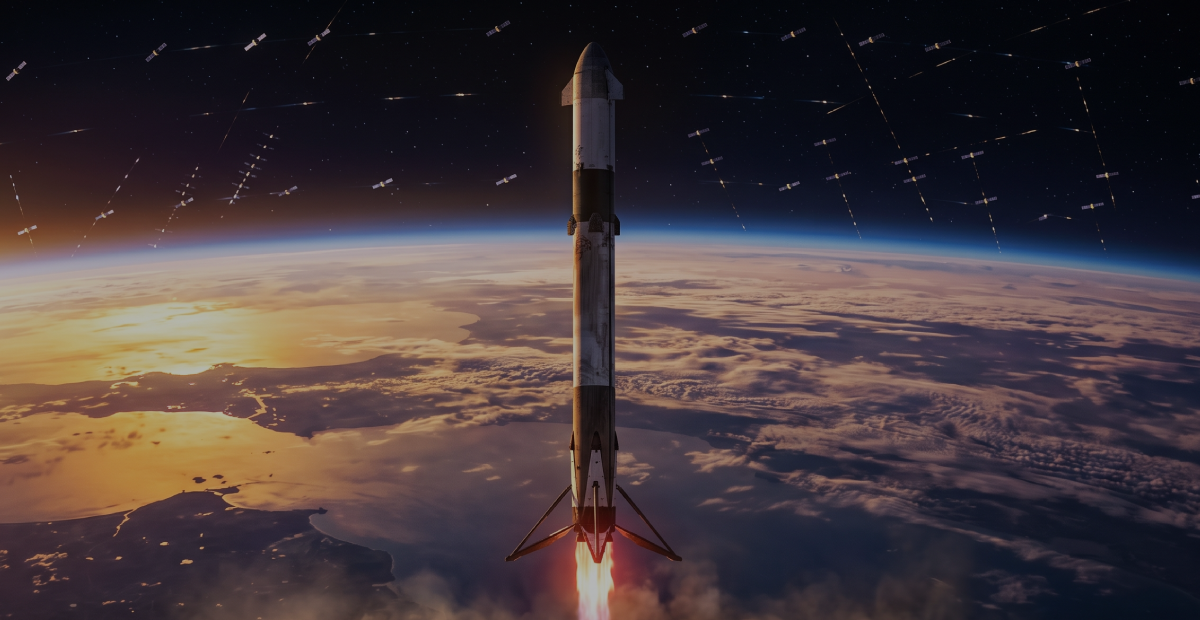
SpaceX asked an obvious but enormously difficult question: what if the rocket could come back?
The company has developed rockets capable of controlling their descent, landing themselves and flying again. It is still working towards making the entire launch system rapidly reusable, but it has already demonstrated that the most expensive components do not necessarily have to be discarded after every mission. That changes the economics completely.
Imagine throwing away the aircraft. Consider what an airline ticket to Australia would cost if, after landing in Sydney, the airline destroyed the aircraft. Before it could sell a return ticket, it would need to manufacture another plane. A single flight would cost millions of dollars.
Commercial aviation works economically because aircraft are reused thousands of times. The cost of building the plane is spread across decades of flights and hundreds of thousands of passengers.
Rockets have historically operated like aircraft that are thrown away after one journey. If SpaceX can make rockets fully and rapidly reusable, launch costs could eventually fall by orders of magnitude, potentially by 99% or even 99.9% compared with the most expensive historical systems. Access to space would no longer be reserved for governments, militaries and the world’s largest companies. It would begin to look like a transport market. And transport infrastructure creates economies.
How do you value an undiscovered economy? This is where conventional valuation becomes difficult. We can build a spreadsheet estimating satellite launches, broadband subscriptions and government contracts, but how do we value businesses that do not exist yet because getting into space has always been prohibitively expensive?
10x to 100x cheaper launches could enable enormous satellite networks, space-based manufacturing, communications infrastructure, scientific research, space tourism, mining and industries that have not yet been imagined. A whole new economy.
Trying to value that opportunity today is like asking a 15th-century investor to calculate the future economic value of the Americas.
Nobody standing on a European dock could have forecast New York, Chicago or São Paulo. They could not have imagined the companies, industries, cities and cultures that would emerge across two continents. A conventional discounted cash-flow model would have been almost useless because most of the future cash flows belonged to activities that did not yet exist.
Near-Earth space, and eventually deep space, may represent something similar today to investors: not simply a new market, but an entirely new economic territory.
Behind the Musk soap opera, that is the real story.
Disclaimer: The views expressed in this article are those of the author at the date of publication and not necessarily those of Dominion Capital Strategies Limited or its related companies. The content of this article is not intended as investment advice and will not be updated after publication. Images, video, quotations from literature and any such material which may be subject to copyright is reproduced in whole or in part in this article on the basis of Fair use as applied to news reporting and journalistic comment on events.


