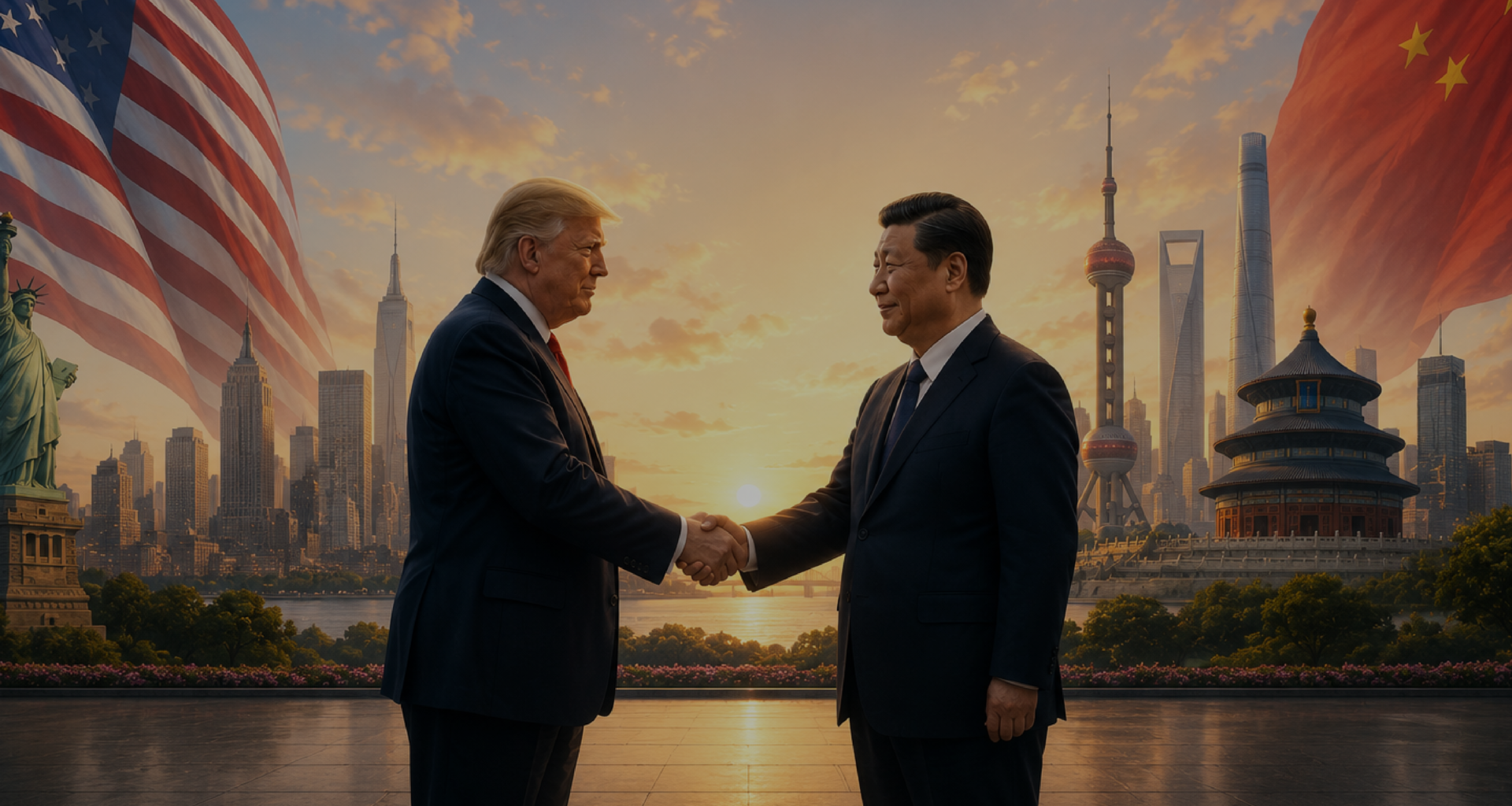
History was made in Beijing last week. For the first time in nearly a decade, an American president set foot on Chinese soil for a state visit. President Trump’s visit to China from the 13th to the 15th of May was his second state visit to the country and the first by any American president since his own trip in 2017. The world was watching, and with good reason.
What made this summit different from past diplomatic encounters was not just its rarity but its composition. Trump did not arrive merely with diplomats and officials. He brought the chief executives of some of America’s most consequential companies, including Tesla’s Elon Musk, Apple’s Tim Cook, BlackRock’s Larry Fink, and Boeing’s Kelly Ortberg, alongside Blackstone’s Stephen Schwarzman, Goldman Sachs’s David Solomon, Citigroup’s Jane Fraser, and Qualcomm’s Cristiano Amon. Jensen Huang of Nvidia was reportedly added at the last minute, securing a seat on Air Force One, underscoring the central role AI chips have come to play in US-China relations. As Wedbush Securities’ Dan Ives noted, “what is at stake is not just one trip or one headline but the direction of AI supply chains.”
The political delegation was equally formidable. Secretary of State Marco Rubio attended, as did Secretary of Defense Pete Hegseth, making him the first defence secretary to accompany a US president on a state visit to China. The sheer scale of the American presence sent its own signal: this was not a courtesy call.
On the Chinese side, Xi called their meetings “historic” and a “landmark,” saying the two sides had reached important understandings on trade, practical cooperation, and addressing each other’s concerns. He also told assembled American executives that the door to business in China would “open wider,” though seasoned observers know that words spoken in grand ceremonial rooms do not always translate into commercial reality.
On trade, Trump was characteristically bullish, claiming the two sides had made “fantastic trade deals, good for both countries.” He said China had agreed to purchase at least 200 aircraft from Boeing, potentially rising to 750 planes. Economists noted, however, that these remain verbal commitments with no guarantee of materialising. The White House also announced a “Board of Trade” and “Board of Investment” to manage the economic relationship going forward, though the enforceability of these structures remains to be seen.
Perhaps no issue better captures the complexity of this relationship than technology. Shortly after Trump met Xi, Reuters reported that Washington had cleared sales of Nvidia’s H200 AI chips to several major Chinese technology firms. Yet not a single chip has shipped to any of the ten approved buyers, rare earth exports remain roughly 50 per cent below pre-restriction levels, and a proposed bilateral AI governance framework produced no signed document. The problem for the United States is stark: China dominates around 85 per cent of rare earth processing and more than 90 per cent of magnet production, giving Beijing significant leverage in any negotiation touching advanced manufacturing and semiconductors.
On Iran, Trump said the two leaders “feel very similar” and noted that both countries want the Strait of Hormuz reopened, a waterway through which roughly a fifth of the world’s oil ordinarily flows. Whether that shared sentiment translates into Chinese diplomatic pressure on Tehran is another question entirely.
So why should any of this matter to the ordinary investor? The United States and China together account for over 42 per cent of global GDP and are the two largest economies in the world. When they cooperate, supply chains function, goods flow, and conditions for global growth are broadly supportive. When they fight, the reverse occurs. The tariff wars of 2025, which saw US tariffs on Chinese goods reach 145 per cent before being reduced to 30 per cent following a trade truce, demonstrated how quickly bilateral friction can ripple into global prices, inflation, and interest rate decisions.
The performance of technology funds, the cost of everyday goods, the trajectory of inflation, and the health of global corporate earnings all have threads running through the Washington-Beijing relationship. As David Shambaugh of George Washington University put it, “some real and not ephemeral stabilisation would be welcomed.”
The meeting of the giants last week was neither a triumph nor a failure. It was a careful holding of ground, a signal that both sides prefer managed competition to open confrontation, at least for now. For investors, that is worth something, even if it falls well short of a grand bargain.
Disclaimer: The views expressed in this article are those of the author at the date of publication and not necessarily those of Dominion Capital Strategies Limited or its related companies. The content of this article is not intended as investment advice and will not be updated after publication. Images, video, quotations from literature and any such material which may be subject to copyright is reproduced in whole or in part in this article on the basis of Fair use as applied to news reporting and journalistic comment on events.


